
By the end of this lesson, you will:
Earlier, you learned that odds can be seen as a representation of probability. If you’ve never studied probability before, don’t worry, you don’t need advanced math to understand this relationship. What matters is grasping the basic idea of what probability means in simple, practical terms.
If you’ve done some mathematics, the word “probability” might sound intimidating. If you haven’t, it may just feel like a normal word and that’s exactly how you should see it.
Probability is simply a measure of how likely an outcome is to occur.
It is always expressed as a number between 0 and 1 or as a percentage between 0% and 100%.
Other everyday words for probability include:
Essentially, probability turns these abstract ideas into numbers so we can work with them.
This is useful in sports betting because you’ll deal with lots of numbers and need to manipulate them to make decisions.
What is the chance that Portugal wins the next FIFA World Cup?
What is the likelihood of getting heads on a coin toss?
🚨 Notice how it’s easy to state the probability for a coin toss, but much harder for Portugal winning the World Cup. That’s because some probabilities are exact (like coin flips), while others must be estimated.
For any outcome, there is one true probability, it exists and it’s unique.
If two people have different probabilities for the same event, at least one is wrong. In sports betting, your goal is to estimate that true probability as closely as possible.
Odds and probability are closely related. In sports betting you can easily convert between them:
The decimal odds of an outcome = 1 ÷ Probability of that outcomeProbability of an outcome = 1 ÷ The decimal odds of that outcomeWhen using the above formulas
Each time you see an outcome, you can now quickly calculate its chance of occurring and vice versa.
Below is a Both Teams to Score market on Stake:
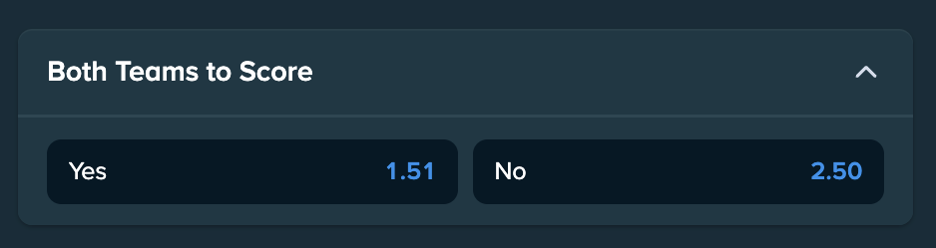
In this market there are 2 outcomes:
The odds for each outcome are:
Using the formula Probability = 1 ÷ Odds, the implied probabilities are:
These are Stake’s implied probabilities, not absolute truths.
You can have your own estimate and often, different bookmakers will have slightly different numbers.
Let’s check the same market on Pinnacle:

The odds for each outcome are:
Using the formula Probability = 1 ÷ Odds, the implied probabilities are:
Pinnacle’s view differs slightly from Stake’s.
Each bookmaker has its own model and risk tolerance, so implied probabilities vary.
If multiple people (or bookmakers) disagree on a probability, who’s correct?. Remember there is only one true probability, and differences between bookmakers can signal opportunity. This concept is the foundation of value betting, which you’ll explore later.
If you’d rather not do the math manually, use the 🔗 free odds to probability calculator on OddsFantasy
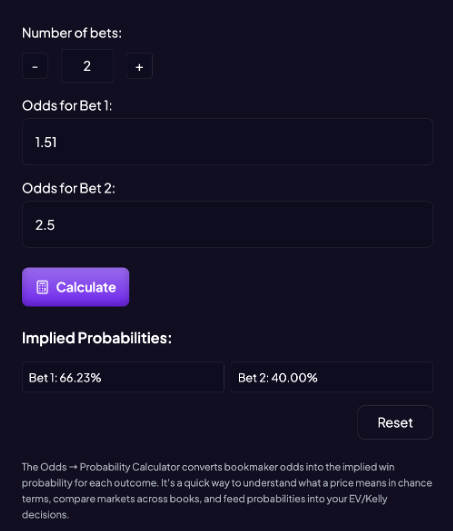
Take a moment to open your bookmaker account and look at a few markets.
Pick some outcomes and calculate their probabilities using the calculator.
Every successful punter understands how odds and probability are connected and how to convert between them.
Decimal Odds = 1 ÷ Probability?The proof requires knowledge in advanced probability and statistics (outside the scope of this lesson). For now, just focus on using the formula confidently.
Probability = 1 ÷ OddsIn the next lesson, you’ll look at odds as a price. You’ll learn how to: