
By the end of this lesson, you will:
If you’ve followed along so far, you now understand what you see on a bookmaker's website the sports, events, markets, outcomes, odds, and bet slip. That’s great! 👏
You can navigate a bookmaker, find a market, and explain what the names and numbers mean. The next step is learning how bets and markets are created in the first place. Without understanding how a market is built, it’s hard to place smart bets.
For the next couple of lessons, you’ll step into the bookmaker’s shoes. This will give you a perspective of betting from the other side before we look at it again from a punter’s point of view.
The process of creating markets, setting odds, and accepting bets is called bookmaking. People or companies who do this are known as bookmakers or bookies. In essence, anyone can act as a bookmaker and today, you’re going to create your first simple book.
Bookmaking may sound complex, but the underlying idea is straightforward and crucial for punters to understand. In real sports betting, bookmaking is advanced and requires a lot of data and resources. To understand it, we’ll use a simple, easy-to-understand event to practise the same concepts bookmakers use at scale.
Let’s go through it step by step 👇
The first step in bookmaking is identifying the event.
In this case, we’ll use a simple event, a coin toss 🪙.
Next, choose a market.
For this example, we’ll use the market "Face Up" meaning which side of the coin faces up after the toss.
(You could also have a market like “Face Down.” There are many possible markets, even for a coin toss!)
List all the outcomes of the market. In this case:
🧐 You can either get heads facing up or tails facing up.
Calculate the probability of each outcome. In this case:
🧐 Clearly, there are just two outcomes. You have a ½ chance of getting heads and a ½ chance of getting tails.
To check if you’ve calculated probabilities correctly, add them together.
If the sum equals 1, you’ve likely done it right.
In this case, 0.5 + 0.5 = 1 ✅
Convert the probabilities into odds using the formula: Decimal Odds = 1 ÷ Probability
✅ Congratulations! You’ve successfully made a simple book:
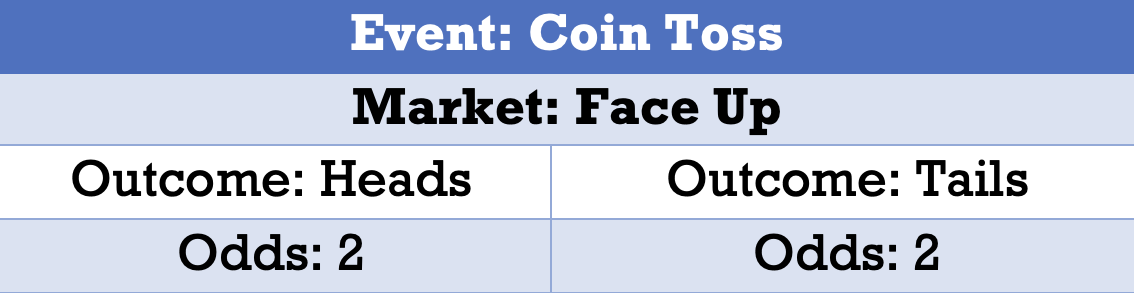
While the book you’ve created is technically correct, it has two major flaws you need to fix before you can run it like a real bookmaker.
If you run the coin toss book exactly as above, the bookmaker (you) won’t make any money. A bookmaker is a business, designed to earn a margin on every market. The goal is to balance the action by having proportional amounts wagered on each outcome ensuring a profit from the built-in margin.
Suppose two punters each place a $100 bet on this book:
Your market liquidity (the total money staked on the market) is:
$100 + $100 = $200
After the coin toss, one punter will win. Their payout:
Payout = Odds × Stake = 2 × $100 = $200
You have the liquidity to pay, so you’ll pay $200 and be left with $0 profit. ☹️
If punters stake uneven amounts, you can be exposed and lose money. 😬
Market liquidity: $100 + $105 = $205
If Heads wins:
Payout = 2 × $100 = $200Profit = $205 – $200 = $5 profit 😁If Tails wins:
Payout = 2 × $105 = $210Profit = $205 – $210 = $5 loss 😣👉 This is pure gambling, and a real bookmaker does not gamble.
A bookmaker secures profit before the event starts, regardless of the outcome.
Before moving on, try taking a different event or a different market on this same event and constructing your own simple books.
With practice, you’ll get faster and start spotting where profit or risk lies.
You probably have a coin so this should be fun!
In the next lesson, you’ll learn about the vig (also called the juice or margin). This is the built-in commission that bookmakers add to their odds to ensure they make a profit no matter which outcome wins. Understanding how to calculate and apply the vig is a key step toward thinking like a bookmaker