
Chapter 4: Inside Bookmaking · Lesson 4
By Cadell Griffith, Software Architect and founder of OddsFantasy · Updated · 6 min read
Line movement is the change in a bet's odds between the moment a market opens and the moment the event starts. Odds move when money, news or a sharper bookmaker's price changes the market's view: in the example in this lesson, Pinnacle's price on Machida Zelvia moved from 2.20 to 1.97, a 5.3-point swing in implied probability.
By the end of this lesson, you will:
So far, you’ve learned how to:
👏 Congratulations! You’ve learned the basics of being a bookmaker!
But there’s one more crucial concept to understand...
When you set a market limit, you don’t want a single bet to use it all up.
If that happens:
💡 Solving this problem causes line movement.
If you’ve been exploring your bookmaker, you’ve probably noticed that odds change 📈📉.
Sports betting odds aren’t fixed; they adjust as money and new information enter the market.
This change is called line movement, and it simply means changing odds. Two words describe its direction:
Bookmakers move lines for four reasons:
If your market limit is $4, you might only allow $0.50 per bet at a time, and adjust your odds a little after each bet.
This approach helps you:
📚 Exactly how much to move a line takes advanced probability and statistics (outside the scope of this course).
But even without mastering the math, knowing about line movement helps you bet smarter.
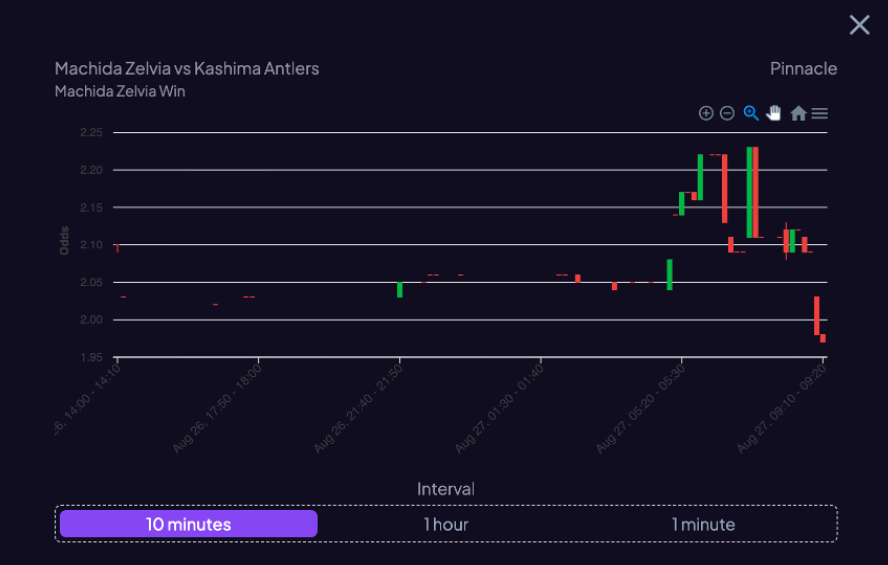
The chart above shows line movement for the Moneyline market in a match between Machida Zelvia and Kashima Antlers on Pinnacle.
The tracked outcome:
Here’s what happened:
| Stage | Odds | Implied probability (1 ÷ odds) |
|---|---|---|
| Opening (26 Aug, afternoon) | ~2.10 | 47.6% |
| Overnight | 2.03–2.06 | 48.5%–49.3% |
| Peak (27 Aug, morning) | ~2.20 | 45.5% |
| Last tracked price (27 Aug, 09:20) | ~1.97 | 50.8% |
The line drifted out to about 2.20, then shortened hard to 1.97 in the final candles. In probability terms, Pinnacle moved Machida’s chance of winning from 45.5% to 50.8%, a 5.3-point swing in a few hours.
Line movement tools, including OddsFantasy, show odds as a candlestick chart. Each candle covers one interval (here, 10 minutes) and shows four prices:
The candle’s colour tells you whether the odds finished the interval higher or lower than they started. A run of tall candles in one direction is a steam move; long flat stretches mean the market agrees with the price.
In the 🔗 OddsFantasy Positive EV tool, the chart icon next to each bookmaker opens that line’s odds history, with 1-minute, 10-minute and 1-hour intervals.
Sports betting is all about markets and odds. As a smart punter, your goal should always be:
Let’s use the chart above as an example 👇
When would you want to place your bet on Machida Zelvia to Win?
✅ At the highest odds (2.20), because it gives you the highest payout!
Let’s compare two punters 👇

Difference: $120 – $97 = 💰 $23 advantage
Just by getting the best odds, you gained $23 extra profit on the same $100 bet, 24% more than the punter who bet late.
Professional punters don’t judge a bet by whether it won. They judge it by whether they beat the closing line, the last odds before the event starts. The closing line is the most accurate price of the day: it has absorbed all the money and news.
CLV = your odds ÷ closing odds − 1
The punter who took 2.20 on Machida, against a closing price of 1.97, has a CLV of 2.20 ÷ 1.97 − 1 = +11.7%. The punter who took 1.97 has a CLV of 0%.
For the most accurate CLV, compare against the no-vig closing price, which you can work out with the vig calculator.
A steam move is a fast odds move across many bookmakers at once, usually started by sharp money at a sharp bookmaker. The soft bookmakers that copy it don’t all move at the same moment. For a short window, a slow bookmaker still offers the old price, which is now better than the fair odds.
That window is a value bet. OddsFantasy’s value feed compares every bookmaker with Pinnacle’s no-vig odds and lists the prices that haven’t caught up yet. In its first 12 hours of tracking (from 21:52 UTC on 15 October 2026) it listed 3,887 pre-match value bets, with a median EV of 3.26% at 1xBet, 2.84% at BC.Game, 2.73% at Stake, 2.61% at Vave and 1.86% on Polymarket (live numbers on supported bookmakers).
Trade responsibly: only bet money you can afford to lose.
In the next lesson, you’ll learn about the different types of bookmakers, Sharp vs Soft, and why it matters which ones you bet with.
Line movement is a change in the odds of an outcome over time. When odds fall (shorten), the bookmaker now rates the outcome more likely; when they rise (drift), less likely. In the Machida Zelvia example in this lesson, Pinnacle's odds moved from 2.20 to 1.97, an implied probability shift from 45.5% to 50.8%.
Bookmakers move odds to manage exposure when money comes in on one side, to price in new information such as injuries, line-ups or weather, and to follow sharp bettors. Soft bookmakers also move their odds to copy sharper bookmakers such as Pinnacle.
Closing line value compares the odds you took with the closing odds, the last price before the event starts: CLV = your odds ÷ closing odds − 1. Taking 2.20 on a line that closed at 1.97 is 2.20 ÷ 1.97 − 1 = 11.7% CLV. Bettors who beat the closing line over many bets have an edge.
A steam move is a fast, large odds move across many bookmakers at once, usually triggered by sharp money at one bookmaker that the others then copy. Soft bookmakers that move last leave a short window of value at their old price.
Bet a value bet as soon as you find it, because it exists only until the slow bookmaker moves. Closing lines are the most accurate prices of the day, so early odds are where mispricings live; late odds are where you check whether you were right.
In the OddsFantasy Positive EV tool, the chart icon next to each bookmaker opens that line's odds history as a candlestick chart, with 1-minute, 10-minute or 1-hour intervals.