
Chapter 3: Markets and Odds · Lesson 3
By Cadell Griffith, Software Architect and founder of OddsFantasy · Updated · 4 min read
Implied probability is the chance a bookmaker’s odds suggest, 1 ÷ decimal odds, and it includes the bookmaker’s margin. True probability is the real chance of the outcome, and true odds are 1 ÷ that chance. Implied probabilities in a market always add up to more than 100% (Stake’s Both Teams to Score prices of 1.51 and 2.50 total 106.23%), while true probabilities add up to exactly 100%.
By the end of this lesson, you will:
Earlier, you learned that odds can be read as a probability. You don’t need advanced math for this lesson; you need one formula and one idea: a bookmaker’s odds tell you its view of an outcome plus its cut, not the outcome’s real chance.
Probability is a measure of how likely an outcome is to happen, a number between 0 and 1, or a percentage between 0% and 100%.
Everyday words for it are chance and likelihood. Some probabilities are exact: a coin toss lands heads with probability 0.5. Others must be estimated: what’s the chance Portugal wins the next World Cup? You might say 30%, someone else 15%.
For any outcome there is one true probability. If two people give different probabilities for the same event, at least one of them is wrong. In sports betting, your goal is to estimate the true probability as closely as possible.
Implied probability = 1 ÷ decimal odds
Decimal odds        = 1 ÷ probability
For a full walkthrough with American and fractional odds, see how to calculate implied probability, or let the odds to probability calculator do it:
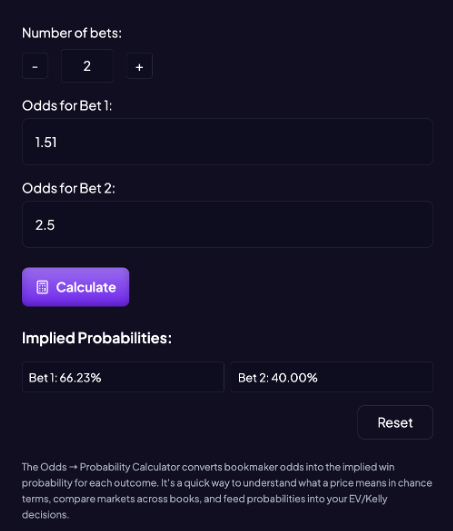
Here is a Both Teams to Score market on Stake for Chelsea FC vs Liverpool FC (English Premier League, 10/04/2025, 5:30 PM GMT+1):

| Outcome | Odds | Implied probability |
|---|---|---|
| Yes | 1.51 | 1 ÷ 1.51 = 66.23% |
| No | 2.50 | 1 ÷ 2.50 = 40.00% |
| Total | 106.23% |
Only one of these two outcomes can happen, yet Stake’s odds give them a combined 106.23% chance. The extra 6.23 points are Stake’s overround.
The same market on Pinnacle:

| Outcome | Odds | Implied probability |
|---|---|---|
| Yes | 1.502 | 66.58% |
| No | 2.68 | 37.31% |
| Total | 103.89% |
Pinnacle’s total is closer to 100%: its overround is 3.89% against Stake’s 6.23%.
To turn implied probabilities into true probabilities, divide each one by the market total so they add up to 100%:
True probability = implied probability ÷ implied total
True odds        = 1 ÷ true probability
| Outcome | Stake true probability | Pinnacle true probability | Pinnacle true odds |
|---|---|---|---|
| Yes | 66.23 ÷ 1.0623 = 62.34% | 66.58 ÷ 1.0389 = 64.08% | 1.560 |
| No | 40.00 ÷ 1.0623 = 37.66% | 37.31 ÷ 1.0389 = 35.92% | 2.784 |
The two bookmakers disagree: Stake rates “Yes” at 62.3%, Pinnacle at 64.1%. Only one true probability exists, so which estimate do you trust?
Pinnacle is a sharp bookmaker (sharp vs soft bookmakers): it takes large bets from professional punters and corrects its prices fast, so its no-vig odds are the best available estimate of the true odds. OddsFantasy prices every value bet against Pinnacle’s no-vig odds for this reason.
Now compare Stake’s prices with Pinnacle’s true odds:
Both Stake prices are below the true odds, so both bets lose money over time, and “No” loses three times as fast. When a bookmaker’s price is above the true odds, the EV turns positive: that’s a value bet, the subject of positive EV betting.
Pick a market on your bookmaker and find the same market on Pinnacle. Calculate both implied totals, remove Pinnacle’s margin to get the true probabilities, and check whether any of your bookmaker’s prices beat the true odds.
In the next lesson, you’ll look at odds as a price: how to calculate the payout of a bet from its odds and stake.
Implied probability is the chance a bookmaker's odds suggest, 1 ÷ decimal odds, and it includes the bookmaker's margin. True probability is the real chance of the outcome. Implied probabilities of a market add up to more than 100%; true probabilities add up to exactly 100%.
True odds are the odds that exactly match an outcome's true probability: true odds = 1 ÷ true probability. A coin toss has true odds of 2.00. For sports, the best estimate of true odds is a sharp bookmaker's price with its margin removed.
Remove the margin from a sharp bookmaker's odds. Pinnacle priced Both Teams to Score Yes at 1.502 and No at 2.68, implied probabilities of 66.58% and 37.31% (103.89% in total). Dividing each by 1.0389 gives true probabilities of 64.08% and 35.92%, or true odds of 1.560 and 2.784.
Because the bookmaker prices every outcome slightly below its true chance to build in its margin. Stake's Both Teams to Score prices of 1.51 and 2.50 imply 66.23% + 40.00% = 106.23%; the extra 6.23 points are the overround.
Implied probability = 1 ÷ decimal odds. Odds of 2.50 imply 1 ÷ 2.50 = 40%. The odds to probability calculator on OddsFantasy converts decimal and American odds for you.