
Chapter 4: Inside Bookmaking · Lesson 3
By Cadell Griffith, Software Architect and founder of OddsFantasy · Updated · 4 min read
A max stake limit is the most a bookmaker will accept on one outcome of a market, and its size tells you how much the bookmaker trusts its own price. A high limit, like Pinnacle’s $1,500 on a Japanese baseball total, means a liquid market with an accurate price; a low one, like Pinnacle’s $200 on an Austrian second-division moneyline, means a thinner market where prices are more often wrong.
By the end of this lesson, you will:
In the previous lessons you built a book and added a margin. Even with a margin, a bookmaker is exposed when one unusually large bet lands on one side. The simplest protection is a cap on how much anyone can stake.
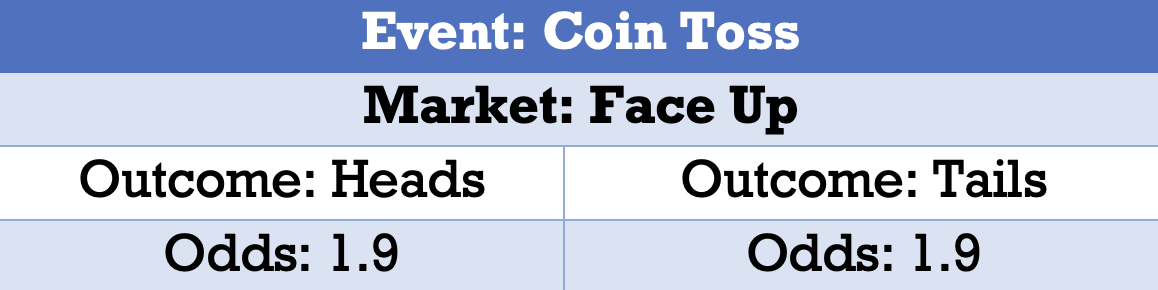
Your coin toss book prices both sides at 1.90, and you have $100 on Heads and $100 on Tails: $200 in, $190 out whichever side lands, a $10 profit.
Now a punter adds $50 on Tails. Your liquidity is $250, and if Tails lands you pay 1.90 × $150 = $285:
$250 − $285 = −$35
One bet turned a guaranteed $10 into a possible $35 loss. 🚨
Bookmakers set a limit on how much one bet can be. It is the easiest way to stop overexposure before it happens.
You want to keep at least $6 profit whatever happens. Each extra dollar on Tails adds $1 of liquidity but $1.90 of payout if Tails lands, so it costs you $0.90 in the worst case:
Worst-case profit = $10 − 0.90 × extra stake on one side
$10 − 0.90 × stake ≥ $6  →  stake ≤ $4.44
So you set the limit at $4. If the punter bets the full $4 on Tails:
| Result | Liquidity | Payout | Profit |
|---|---|---|---|
| Heads wins | $204 | 1.90 × $100 = $190 | $14.00 |
| Tails wins | $204 | 1.90 × $104 = $197.60 | $6.40 |
🛡️ Your worst case is still a profit. To take more money on Tails, you would move the odds to attract bets on Heads first.
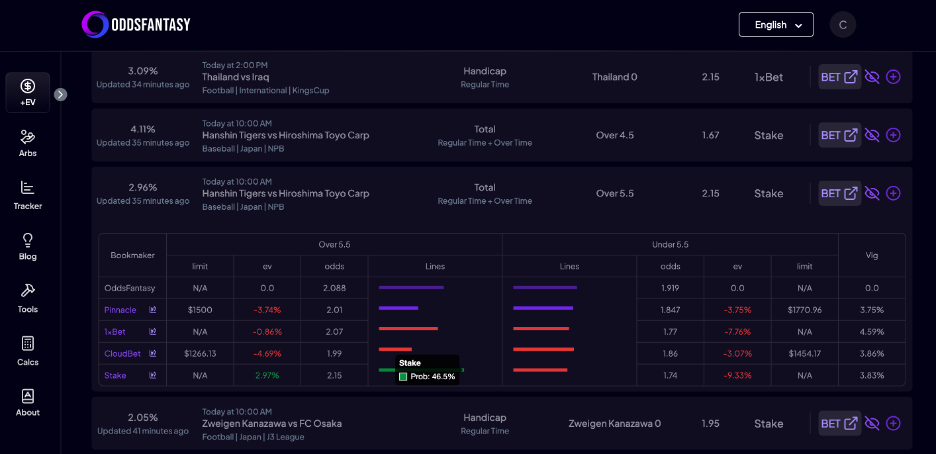
A limit is the bookmaker telling you how confident it is in a price. Here are real limits from the OddsFantasy Positive EV tool, starting with the Hanshin Tigers vs Hiroshima Toyo Carp total (Japanese NPB baseball):
| Bookmaker | Market | Limit per bet | Margin |
|---|---|---|---|
| Pinnacle | Hanshin vs Hiroshima, Over / Under 5.5 | $1,500 / $1,770.96 | 3.75% |
| Cloudbet | Same total | $1,266.13 / $1,454.17 | 3.86% |
| Pinnacle | Bregenz vs Liefering, Austrian 2. Liga moneyline | $200 per outcome | 5.24% |
| Cloudbet | Same moneyline | $167.46 per outcome | 6.39% |
Pinnacle takes 7.5 times more on the baseball total than on the Austrian second-division match, and charges a lower margin on it. Bigger, better-known markets get higher limits and tighter prices.
How to read them:
The limits above apply to every customer on a market. Bookmakers also set account limits: restrictions on one customer, usually one who wins consistently. Soft bookmakers cut winning accounts to tiny stakes; sharp bookmakers don’t. Read betting limits for how account limits work and how to deal with them.
On prediction markets and exchanges such as Polymarket there is no bookmaker limit at all. The most you can trade at a price is the liquidity in the order book at that price.
In the next lesson, you’ll learn about 📈 line movement: how and why odds shift as money arrives, and how to use those moves to your advantage.
The largest bet a bookmaker accepts on one outcome of a market at the current odds. On the Hanshin Tigers vs Hiroshima Toyo Carp total in this lesson, Pinnacle accepted up to $1,500 on Over 5.5 and $1,770.96 on Under 5.5.
To stop one bet from unbalancing the book. In this lesson's coin toss book, one extra $50 bet turns a $10 profit into a $35 loss; a $4 limit keeps the worst case at a $6.40 profit.
That the bookmaker has less information and less money in the market, so it doesn't trust its price enough to take big bets. Low limits appear on lower leagues, niche markets and lines that have just opened, which are also where prices are most often wrong.
Yes. Sharp bookmakers open markets with low limits and raise them as money and news sharpen the price towards kickoff. After a large bet, a bookmaker usually moves the odds before taking more on the same side.
A market limit is the maximum stake for every customer on that market. An account limit is a restriction a bookmaker places on one customer, often a winning one, which lowers the maximum stake for that account only.