
Chapter 4: Inside Bookmaking · Lesson 2
By Cadell Griffith, Software Architect and founder of OddsFantasy · Updated · 4 min read
Overround is how far a market’s implied probabilities add up above 100%, and the bookmaker margin is that excess as a share of the total, the cut the bookmaker keeps. A two-way line at 1.909 on each side adds up to 104.77%: an overround of 4.77% and a margin of 4.55%. Divide each implied probability by 1.0477 and you are back at the fair odds of 2.00.
By the end of this lesson, you will:
A bookmaker doesn’t charge you a fee when you place or win a bet. Its commission is built into the odds: as you saw in what is bookmaking, every outcome is priced slightly below its fair value. This lesson measures that commission.
You’ll see it called the vig, vigorish, juice, hold or margin. For the vig as a term and how it differs across sportsbooks, read the vig in sports betting; to calculate it instantly, use the vig calculator.
Each decimal price implies a probability: implied probability = 1 ÷ odds. In a fair market those probabilities add up to exactly 100%. In a bookmaker’s market they add up to more, because every price has been cut.
In the last lesson you built a fair book at 2.00 each side. Cut both prices to 1.90:
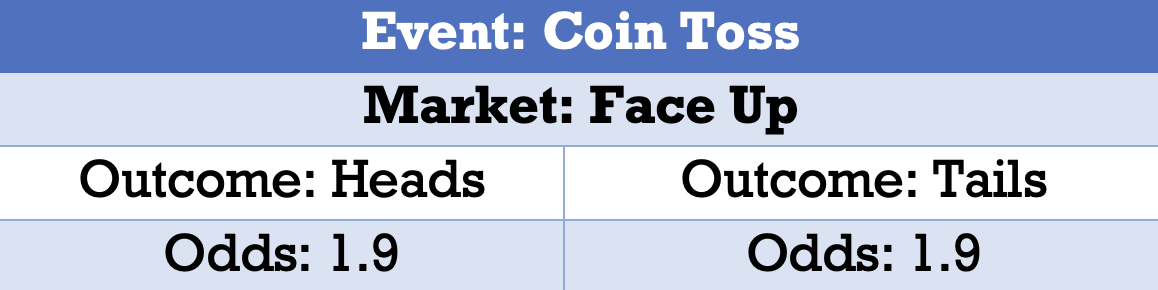
That $10 is 5% of the $200 staked. The market’s margin is 5%.
Both numbers come from the same total, and both are in common use:
Implied total = 1 ÷ odds A + 1 ÷ odds B (+ 1 ÷ odds C ...)
Overround     = implied total − 1
Margin        = 1 − 1 ÷ implied total
RTP           = 1 ÷ implied total
The margin is the one that matters to your wallet: it is the share of all money staked that the bookmaker keeps. The return to player (RTP) is the rest.
| Market | Odds | Implied total | Overround | Margin | RTP |
|---|---|---|---|---|---|
| Coin toss, your book | 1.90 / 1.90 | 105.26% | 5.26% | 5.00% | 95.00% |
| Standard −110 / −110 line | 1.909 / 1.909 | 104.77% | 4.77% | 4.55% | 95.45% |
| Bregenz vs Liefering 1X2, Pinnacle | 2.58 / 3.93 / 2.42 | 105.53% | 5.53% | 5.24% | 94.76% |
| Bregenz vs Liefering 1X2, Stake | 2.60 / 3.60 / 2.20 | 111.69% | 11.69% | 10.47% | 89.53% |
Same match, two bookmakers: Stake keeps twice the share of every stake that Pinnacle does. 📉 The higher the margin, the lower your RTP, and the more you lose (or the less you win) over the long run.
Removing the margin, also called de-vigging, turns a bookmaker’s prices back into fair odds. Fair odds are what you compare every bet with to find positive EV. There are two common methods.
Divide each implied probability by the implied total, which is the same as multiplying each price by the total:
Fair odds = bookmaker odds × implied total
For Pinnacle’s Bregenz prices (total 1.0553):
These are the fair odds OddsFantasy’s Positive EV tool showed for this match, and against them 1xBet’s 2.79 on Bregenz was a +2.46% value bet (sharp vs soft bookmakers).
Take the same amount off every implied probability: (total − 1) ÷ number of outcomes. For the Bregenz market that is 0.0553 ÷ 3 = 1.84 points each, giving fair odds of 2.709 / 4.237 / 2.533. The OddsFantasy vig calculator uses this method.

On two-way markets with similar prices, such as −110 / −110, both methods give the same answer (2.00 / 2.00). They differ when one outcome is a long shot: the equal-share method moves more of the margin onto the long shot, the proportional method spreads it evenly by price. Pick one and use it consistently when you compare bets.
Open your bookmaker and pick three markets: a 1X2, a total and a player prop. Calculate the implied total and the margin of each. You’ll see the main market carries the smallest margin.
In the next lesson, you’ll see how bookmakers protect a book from one big bet with stake limits, and what the size of a limit tells you about a market.
Overround is how far the implied probabilities of a market add up above 100%. Odds of 1.909 on both sides of a two-way market imply 52.38% + 52.38% = 104.77%, an overround of 4.77%.
Overround is the excess over 100% (total − 1). The margin is that excess as a share of the total (1 − 1 ÷ total), which is the share of all money staked that the bookmaker keeps. A 104.77% market has a 4.77% overround and a 4.55% margin.
Add up 1 ÷ decimal odds for every outcome of the market, then margin = 1 − 1 ÷ that total. For Pinnacle's 2.58 / 3.93 / 2.42 on a football 1X2, the total is 1.0553 and the margin is 1 − 1 ÷ 1.0553 = 5.24%.
The proportional method divides each implied probability by the market total, which is the same as multiplying each price by the total: 2.58 × 1.0553 = 2.723. The equal-share method takes the same amount, (total − 1) ÷ number of outcomes, off every implied probability. The OddsFantasy vig calculator uses the equal-share method.
The lowest one you can find for the market you want to bet. On the same Austrian 2. Liga match, Pinnacle's margin was 5.24%, 1xBet's 5.73%, Cloudbet's 6.39% and Stake's 10.47%. Main markets at sharp bookmakers carry the lowest margins.
Return to player (RTP) is the share of all money staked on a market that the bookmaker pays back: 1 ÷ the implied total, or 1 − margin. Pinnacle's 5.24% margin is an RTP of 94.76%; Stake's 10.47% margin is an RTP of 89.53%.