
Chapter 5: Data-Driven Sports Betting · Lesson 6
By Cadell Griffith, Software Architect and founder of OddsFantasy · Updated · 6 min read
To arbitrage bet, find an event where the best odds at different bookmakers add up to less than 100% implied probability, then split your stake so every outcome pays the same. For example, 1.909 at Pinnacle and 2.2 at SportyBet total 97.84%, so $268 and $232 return at least $510.40 on $500 whichever player wins.
By the end of this lesson, you’ll be able to:
New to the idea itself? Arbitrage betting explained covers what arbs are and why they exist. The rest of this lesson works through each step with real numbers.
In the lesson on odds as probability you learned that 1 ÷ odds is the implied probability of an outcome. A bookmaker’s implied probabilities always add up to more than 100%; the extra is its vig.
Take the best odds for each outcome across all bookmakers and add up their implied probabilities:
Arb total = 1 ÷ odds A + 1 ÷ odds B (+ 1 ÷ odds C)
Return on total stake = 1 ÷ arb total − 1
Here’s an arb between Pinnacle and SportyBet found by the 🔗 OddsFantasy Arbitrage Tool.
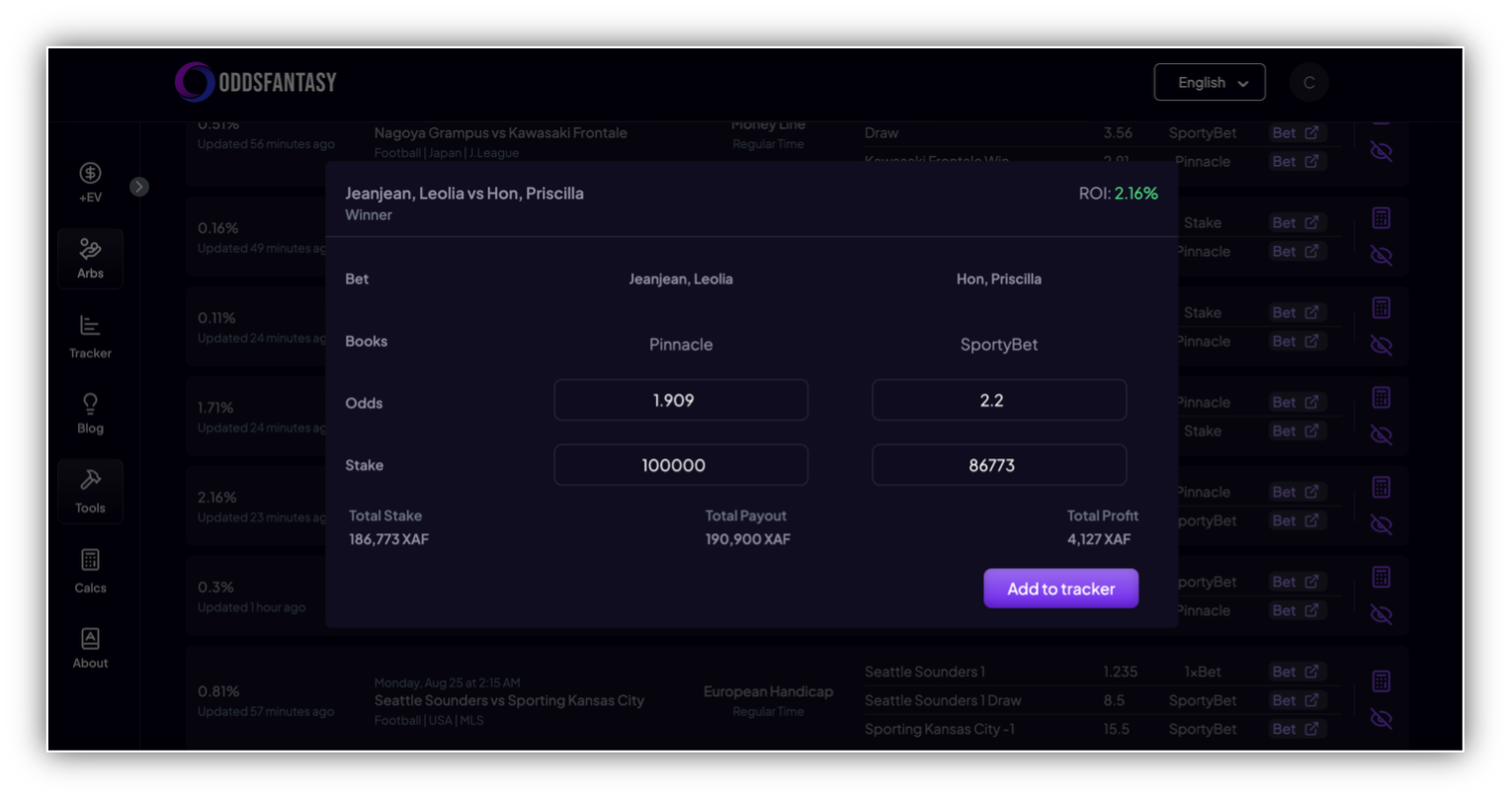
The Event: Jeanjean, Leolia vs Hon, Priscilla
Market: Money Line

| Outcome | Bookmaker | Odds | Implied probability |
|---|---|---|---|
| Jeanjean, Leolia | Pinnacle | 1.909 | 52.38% |
| Hon, Priscilla | SportyBet | 2.2 | 45.45% |
| Total | 97.84% |
The total is below 100%, so this market is an arb. The return is 1 ÷ 0.9784 − 1 = 2.21% of whatever you stake in total.
Each outcome gets a share of your total stake equal to its share of the arb total:
Stake on an outcome = total stake × (1 ÷ its odds) ÷ arb total
Payout (any outcome) = total stake ÷ arb total
With a $500 total stake:
Bookmakers take whole amounts more easily, so round to $268 and $232. The 🔗 OddsFantasy Arbitrage Calculator does the same split:
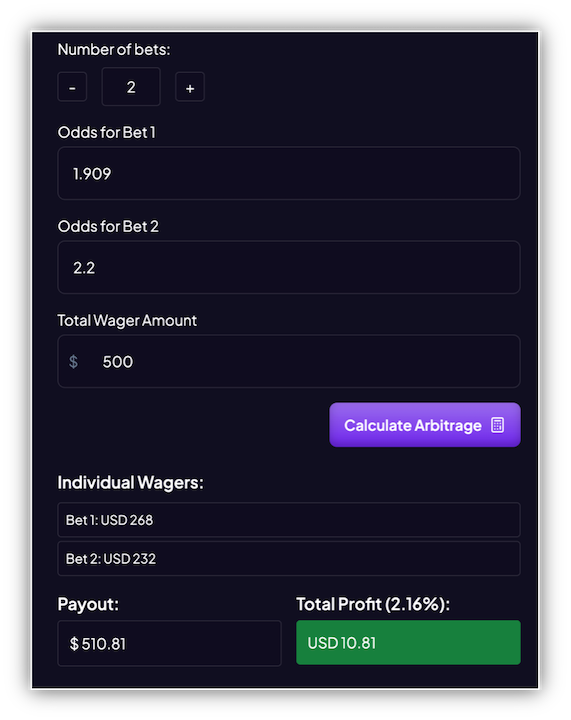
No matter who wins:
You stake $500 and get back at least $510.40: a profit of $10.40 to $11.61 whichever player wins.
Football’s 1X2 market has three outcomes, so you need three bets. Say the best prices across three bookmakers are:
| Outcome | Bookmaker | Odds | 1 ÷ odds | Stake from $1,000 | Payout |
|---|---|---|---|---|---|
| Home | Book A | 2.45 | 40.82% | $413 | $1,011.85 |
| Draw | Book B | 3.60 | 27.78% | $281 | $1,011.60 |
| Away | Book C | 3.30 | 30.30% | $306 | $1,009.80 |
| Total | 98.90% | $1,000 |
The arb total is 98.90%, so the return is 1 ÷ 0.989 − 1 = 1.12%, about $10 on $1,000. Three legs means three chances for a price to move before you finish, which is why 3-way arbs need speed.
OddsFantasy records every arbitrage its feed lists. In the first 12 hours of tracking (from 21:52 UTC on 15 October 2026) the feed listed 3,113 pre-match arbitrage opportunities.
| Bookmaker | Arbs it was part of | Median return before fees |
|---|---|---|
| 1xBet | 2,110 | 0.41% |
| Pinnacle | 1,349 | 0.38% |
| Polymarket | 1,111 | 0.42% |
| Vave | 864 | 0.37% |
| BC.Game | 410 | 0.53% |
| Stake | 382 | 1.06% |
The bookmaker pairs behind the most arbs were 1xBet + Polymarket (781), 1xBet + Pinnacle (686) and Pinnacle + Vave (375). The supported bookmakers page shows these numbers live.
Two lessons from the data:
Arbitrage exploits differences in bookmakers’ odds. Each bookmaker manages its risk and exposure independently, and soft bookmakers update their prices more slowly than sharp ones. Gaps appear most often in:
By sizing your stakes correctly, you lock in the return before the odds adjust.
An arb only pays if every leg stands at the price you calculated. These are the ways it fails:
More arbitrage bets are listed live on the 🔗 OddsFantasy Arbitrage tool.
Trade responsibly: only stake money you can afford to lose.
Add up 1 ÷ odds for every outcome, each at the best price you can find. If the total is below 1 (below 100%), the market is an arbitrage. For odds of 1.909 and 2.2 the total is 0.5238 + 0.4545 = 0.9784, so it is a 2.21% arb.
Stake on each outcome = total stake × (1 ÷ that outcome's odds) ÷ the sum of 1 ÷ odds for all outcomes. Every outcome then returns the same payout, total stake ÷ that sum. The OddsFantasy arbitrage calculator does this for 2 to 9 outcomes.
Most arbs are small. In the first 12 hours of tracking from 15 October 2026, the median arbitrage in OddsFantasy's feed returned 0.37% to 0.53% of the total stake before fees at most bookmakers, about $4 to $5 on a $1,000 arb. Stake arbs were the richest at a 1.06% median.
Placing bets at different bookmakers is legal wherever those bookmakers are allowed to operate. Bookmakers don't ban arbitrage by law, but soft bookmakers limit or close accounts that bet arbs often. Exchanges and prediction markets such as Polymarket don't restrict winning accounts.
An arbitrage covers every outcome and locks in a small return on the event. A positive EV bet takes one side at odds above its fair price and wins more than it loses over many bets, with swings along the way. Arbs return less per bet; positive EV bets return more over time.
An arb exists only while one bookmaker's price lags the rest of the market. As soon as that bookmaker updates its odds, or a sharp book moves, the gap closes. That's why you place the leg at the slower, softer bookmaker first.